Workflow stewardship
Versioned configuration, scripts, environments, tests, and release documentation support repeatable builds.
Maintained public genomic-surveillance resource
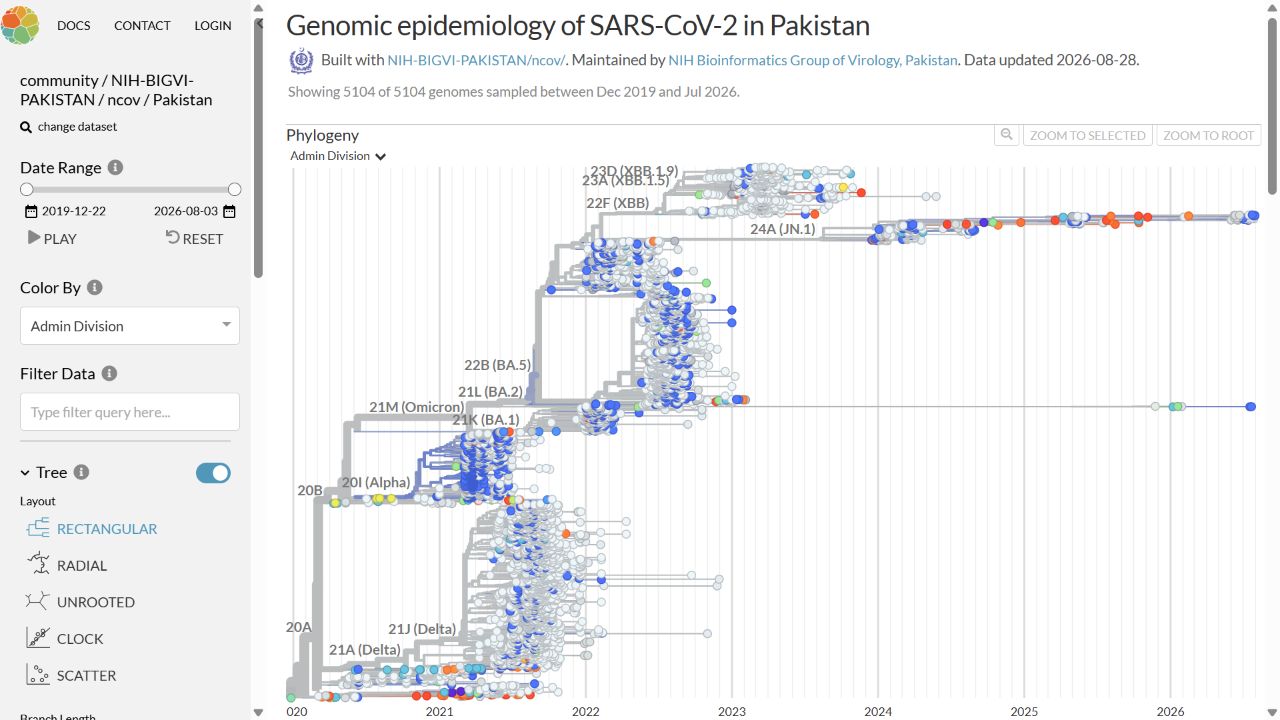
I maintain the reproducible analysis and publishing workflow behind the NIH Bioinformatics Group of Virology’s Pakistan-focused public build—connecting quality control, time-resolved phylogenetics, responsible data handling, and interactive outbreak communication.
Contribution
The public build is presented institutionally by the NIH Bioinformatics Group of Virology, Pakistan. My contribution is the reproducible workflow and the publishing path that carries a reviewed build from controlled inputs to the institutional repository and then to the public Nextstrain Community view.
Versioned configuration, scripts, environments, tests, and release documentation support repeatable builds.
Sequence quality, metadata consistency, filtering decisions, phylogeny, and time structure are reviewed as one chain of evidence.
Auspice turns the reviewed output into an explorable view while the written record preserves scope and interpretation limits.
Nextstrain Community builds are independently maintained resources hosted through GitHub. The wording here distinguishes this resource from datasets maintained directly by the Nextstrain team.
Reproducible workflow
Locally held GISAID sequence and metadata files are mapped into the documented Pakistan build profile.
Nextclade quality signals and workflow filters identify records that do not meet the build criteria.
Pakistan sequences are combined with a bounded international context set for more careful interpretation.
The Nextstrain SARS-CoV-2 workflow uses IQ-TREE to estimate the tree from the retained alignment.
TreeTime places genomic relationships on a temporal scale and supports the dated public view.
Auspice JSON is released through the institutional repository, with the reusable workflow versioned and archived separately.
Data governance
This separation makes the analytical method inspectable without representing access-controlled sequence data as unrestricted material. It also keeps the public repository usable as a reproducibility record.
Public records
Discuss the work